STOCKS 101 #5 – What moves stock prices?
Here’s something I didn’t really think about when I first started investing — why do stock prices actually change? I knew they went up and down, and I could see it happening in real time while looking at stock charts, but I never really stopped to think about what was actually causing it to move; it just did.
In this post, we’ll break down the key ideas behind how stock prices move, and some of the common terms used to describe different market behaviours.
In this post, you’ll learn:
- What causes stock prices to change
- What bull and bear markets are
5.1 What determines stock price changes?
To understand what causes stock price movements, we need to learn one of the basic principles in Economics – supply and demand. Here is the generic explanation of how supply and demand correlates:
- When demand is greater than supply = the price increases
- When supply is greater than demand = the price decreases
Let’s go through in details about why this occurs. For this example, let’s look at a real-life scenario that most may be familiar with, shoe re-selling. Imagine you managed to purchase one of those rare shoes (like Yeezy’s), and then you decide that you want to sell it off, so you list your shoe on eBay. Here are the 2 scenarios:
Scenario 1
When you list the shoes on eBay for £100, you find out that you are the only one that’s selling them. There are 10 potential buyers that are interested in your shoes. This means the demand is 10, while the supply is just 1 quantity – so what’s going to happen?
Well, the 10 buyers would need to convince you to sell it to one of them, and the way they do it would be to outbid each other by offering a higher price; buyer A might offer to buy for £110, then buyer B might offer £120, and so on and on until they reach a price where no further bids are made, e.g. £200. So because the demand was greater than supply, the price increased from £100 to £200.
Scenario 2
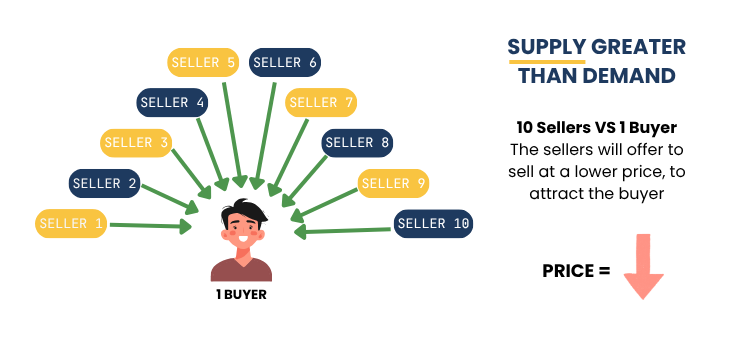
When you list the shoes on eBay, you now notice that there are actually 9 others selling the same shoe – so this time the total supply is 10 quantity, each listing it for £100 each. But in this scenario there is only 1 potential buyer – what happens now?
The 10 sellers have to convince that 1 buyer to buy it from one of them. To do this, they would need to offer a lower price to attract that buyer, since right now everyone is offering to sell it for the same price. Seller A might offer to sell for £90, then seller B might go down to £80, and so on and on until they reach a price where any seller isn’t willing to go lower, e.g. £50. Therefore, since the supply was greater than demand, the price decreased from £100 to £50.
That was a simplified explanation, but it should give you an idea of this concept. We can use this concept to explain the stock price movements – when there are more buyers than sellers, the stock price increase, and when there are more sellers than buyers, the stock price decreases. Remember, these stock trades are happening very quickly, and the volumes of each stock being traded are usually in thousands/millions quantity, so the stock prices fluctuates by the second!
Above explains why stock prices move up or down, but the actual reasoning which causes there to be more buyers or sellers will vary a lot – it could be macroeconomics (such as interest rates, inflation, etc), or could be good/bad news specifically related to that stock, we will cover these in later posts.
Fig 1 — illustration of how stock price moves when demand is greater than supply
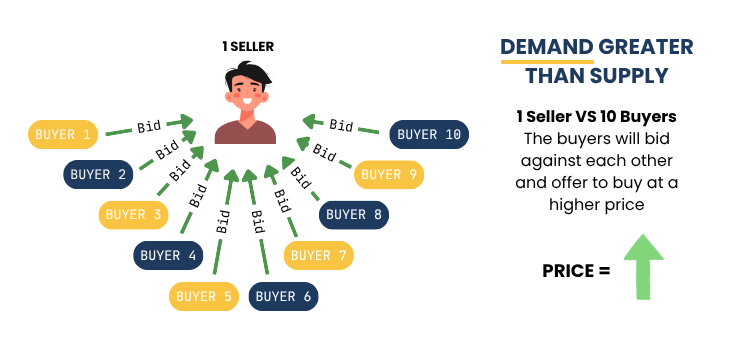
Fig 2 — illustration of how stock price moves when supply is greater than demand
5.2 What is bull and bear market?
The concept of “bull” and “bear” within the stock market is definitely something I find quite fun. These were two words I would constantly hear or read about when I first started, and I as I learnt more about it, it kind of just made sense.
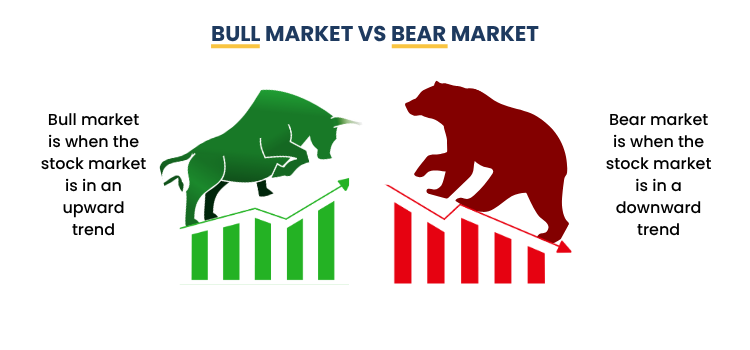
A “bull market” is when the stock market is in an upward trajectory – think of this as when the economy is booming, the world is at peace, and everything is going well. The best example is after the recovery from the 2008 recession – the stock market started rallying up from 2009 and began the longest ever bull market in the history, lasting almost 11 years until 2020
On the other hand, a “bear market” is the exact opposite – this is when stock market is moving downwards. A perfect example is the coronavirus era of 2020; the entire world came to a halt, there was economic uncertainty everywhere, and the stock market tanked.
In summary, the bull and bear market terms are used to describe whether the market is trending up or down. The term is also commonly used to describe an investors opinion about certain stocks – if someone believes strongly about a particular stock and thinks it will go up, then they are “bullish”, if they believe the opposite, then they are “bearish”.
Now you may be wondering why exactly these 2 animals were picked to describe market trends (I know I certainly did)? It all comes down to how these animals attack:
- A bull attacks by thrusting their horns upward, representing the market trending up
- A bear attacks by slashing its paws downwards, representing the market trending down
Fig 3 — illustration of bull vs bear market
And that brings us to the end of the fundamentals of the stock market! Between this post and the previous ones in this series, you should now have a really solid foundation of how the stock market works — from the core concepts, to how you can invest, to what actually drives stock prices up and down. Honestly, if I’d had all of this laid out for me when I first started back in 2018, it would have saved me a lot of confused Googling!
From here, the “Stocks 101” series is going to start getting into the more practical side of things — like how to actually analyse stocks (we’ll learn about key metrics, and how to read financial statements), and how to start building your own portfolio. So see you there!
As always, if you have any questions, feel free to drop them in the comments below. And if you’ve found this series helpful so far, feel free to share it with anyone else who’s just starting out on their finance journey!