STOCKS 101 #2 – Stock Market Core Concepts
The more you learn about the stock market, the more questions you end up with — trust me, I’ve been there.
I remember when I first started getting into investing, I’d often come across a new word I’d never heard of before — and then I’d have to Google that, which led to another unfamiliar one, and before I knew it I had about 10 tabs open and had fallen through this rabbit hole of information!
The truth is, the stock market sort of comes with its own language — and until you get familiar with it, a lot of the information out there will just feel more confusing. So in this post, I want to build on the foundation from the previous post and go through some of the core concepts you’ll come across all the time when learning about stocks. Get these under your belt, and things will start to click a lot faster as you continue on your investing journey.
In this post, you’ll learn:
- Who the different participants in the stock market are
- What market capitalisation is
- What ticker symbols are
- What stock indexes are and why they matter
2.1 Who are the different participants within the stock market?
If we simplify things, we can generally split people within the stock market into 2 groups: retail investors and institutional investors.
Retail investors are individuals, like you and me, who buy/sell stocks for our personal portfolio. We don’t trade in very large volumes – it will differ from person to person, some might buy a single share at a time, others may buy 10/20/100 shares at a time.
Institutional investors are larger companies that trade in massive volumes (millions worth of shares at a time). Some examples would be investment firms (such as Hedge Funds) who invest other people’s money, banks , and even pension funds (yes, even your pension is being invested within the stock market).
2.2 What is market capitalization?
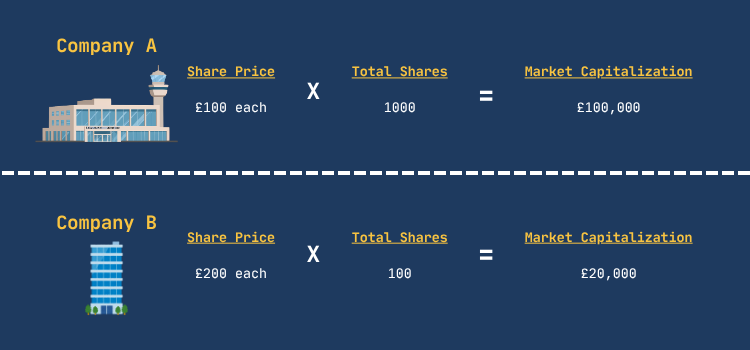
Before we get into the definition, let’s first talk about stock prices. It did come as a surprise to me when I learnt that the stock price doesn’t actually tell us much about the company. One of the common misconceptions (and one I used to make when I first started) is thinking that the company with the higher stock price is the “bigger” company. For example, let’s look at these 2 companies:
- Company A has stock price of £100
- Company B has stock price of £200
Yes, company B’s stock is more expensive to buy, but just by looking at the price we can’t say whether it is the bigger company out of the two. What we need to compare is the “market capitalisation” (commonly referred to as “market cap”):
- Market cap = Stock Price x Total number of shares of that company (referred to as ”outstanding shares”)
So the market cap is what shows you the total “value” of that company within the stock market, hence why it is so important. This is the metric that is used by investors to determine the size of that company – not the stock price.
Using the above examples, let’s say Company A has total number of shares of 1000, whereas Company B only has 100. With this we can calculate the market cap as follows:
- Company A: £100 x 1000 shares = £100,000
- Company B: £200 x 100 shares = £20,000
As you can see, even though the stock price of B was higher, it turns out A is the bigger company.
Let’s look at a real life example of this using 2 of the biggest companies: Google Vs Meta (formerly known as “Facebook”)
Right now (March 2026), the stock price of each is hovering around the following:
- Google = $300 vs Meta = $650
However, if we look at their market cap:
- Google = $3.7 Trillion vs Meta = $1.7 Trillion
So even though Meta’s stock price is more than double of Googles, Google is a far larger company since their market cap is more than double of Meta’s!
Fig 1 — showing how market capitalization is calculated
2.3 What is a ticker symbol?
Official company names can sometimes be quite lengthy – for example, Google’s official name is “Alphabet Inc.”, whereas Meta’s is “Meta Platforms, Inc”. If I had to write their full names every time I mention them in this post, that could be quite time consuming! Now, imagine if there was a much quicker way of identifying these companies, using a shortened version of their names – well, that’s exactly what a ticker symbol is; a unique identifier of a stock, usually between 1-5 letters long in capital letters.
Using the companies from previous examples, here’s the ticker symbol for them:
- Alphabet Inc. = GOOG
- Meta Platforms, Inc = META
Let’s look at few more examples of companies with different length ticker symbol:
| Company Name | Ticker Symbol |
|---|---|
| Ford Motors | F |
| Coca-Cola | KO |
| McDonalds | MCD |
| Microsoft | MSFT |
Ticker symbol also makes it easier to read stock data – imagine looking at various different stocks and their prices, it would be far easier to just read their ticker symbols rather than full names. Therefore, it usually helps if you get familiar with the ticker symbols of stocks that you own or are interested in.
2.4 What are stock indexes?
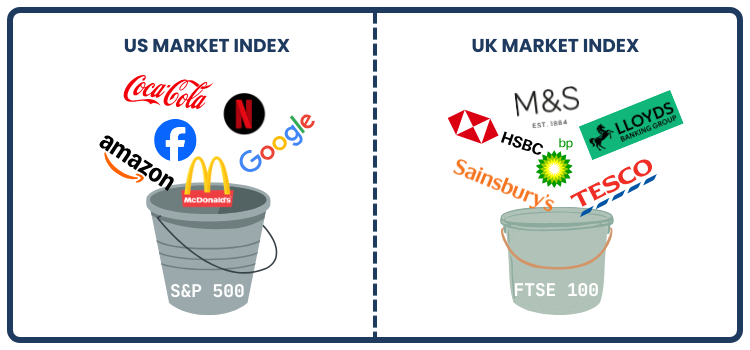
Stock indexes are a tracker of specific markets (e.g. the US market, the UK market, Asian market, etc) – it gives us an idea of how that market is performing at the moment. The most popular one, which you’ve most likely heard of, is the “S&P 500” (S&P stands for “Standard & Poor’s”, the company who created this index). This index tracks how the 500 biggest market cap companies in the US (mega corporations such as Apple, Microsoft and Google) are performing – it is often used as general indicator of how the US market is performing. So if the S&P 500 is up, then it would indicate that the US market is performing well, if it’s down then it’s the opposite. *note: indexes are regularly updated to add/remove companies. The list of companies in S&P 500 from 20 years ago will be far different than what it is today
Other popular indexes are:
- NASDAQ 100 – the 100 largest non-financial companies that are listed on the NASDAQ stock exchange. This index contains a lot of technological companies, so it’s often viewed as a tech index
- FTSE 100 – the 100 largest market cap companies listed in the LSE (London Stock Exchange)
Indexes are mainly used for 2 things:
- Retail investors use it to compare how their personal portfolio is performing. Normally, a lot of people’s goal will be to beat the S&P 500’s performance in the long haul, if their portfolio has a greater return than S&P 500 then they are doing really well
- These indexes also form the basis of some of the popular investment products — but we’ll get into that in more details on the next post
Fig 2 — example of US stock market index vs UK stock market index
And that’s a wrap on some of the key concepts within the stock market. Honestly, when I first came across some of these, it took a bit of time to fully sink in, so take your time to digest this information – the more you read and learn, the more natural these terms will start to feel.
In the next post of the “Stocks 101” series, we’ll start looking at the different ways you can actually invest your money in the stock market, including things such as mutual funds and ETFs. See you there!
As always, if you have any questions, feel free to drop them in the comments below.