STOCKS 101 #4 – Dividends: Income from stocks
Imagine a company that gave you money simply for holding their stock, wouldn’t that sound too good to be true? When I first came across this concept, I was sceptical and was certain that I had misunderstood something somewhere. But as I researched into it more, it turned out to be completely real! — and it opened the doors to a completely new way of investing.
This concept is called “Dividends”, and it’s one of my favourite topics to talk about, because for a lot of people it’s that lightbulb moment where investing starts to feel really exciting.
In this post, you’ll learn:
- What dividends are and why companies pay them
- How much can you earn from dividends
- When do dividends get paid out to you
- Key metrics to lookout for
- Benefits of dividend investing
4.1 What are dividends and why are they paid out?
We’ve just learnt that dividends are money paid out by the company over to you, simply for holding their stock. But why exactly would they just give you free money like this? Well, you can think of a dividend like a bonus that a company pays you, to reward you for being one of their shareholders. Aside from rewarding the shareholders, one of the primary reason companies offer dividends is in order to attract more investors – you are literally receiving additional money, on top of existing shares that you hold; wouldn’t you be tempted to buy it?
Do all companies give out dividends? The answer is no. Generally speaking, a company has to be a profitable company in order to give out dividends, since they will need money to pay it out. A lot of companies that do give out dividends tend to be large, established companies who have been profitable for a long time (e.g. Coca Cola and Pepsi). This is another reason which attracts investors, since it shows to them that the company is in a great financial position, as they are able to share the profits with shareholders.
4.2 How much money do you actually get as a dividend?
The question you’ve probably been wondering for a while. Well, the amount of dividend paid out by a stock will be determined by its “Dividend yield”; it’s shown as a percentage and it represents how much money you will receive annually for the value of stocks you own of that company.
The dividend yield is calculated by taking the “Annual Dividend per share” (the amount per each share that the company has decided to pay out as dividend for the year) and dividing it by the current stock price:
- Dividend Yield = (Annual Dividend per share/Current share price) x 100
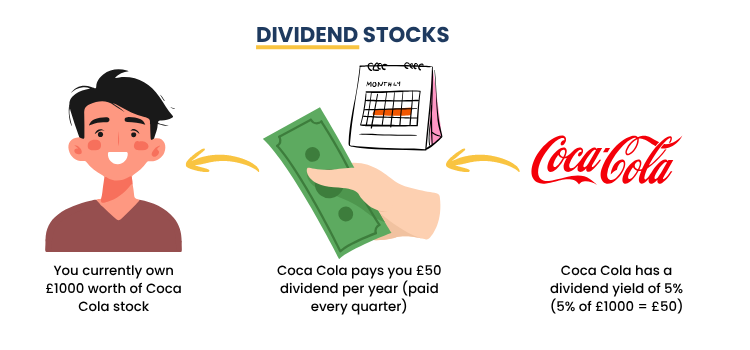
So, let’s say a company decides to pay out £5 dividend per share, and the current share price is £100. This would mean the dividend yield is 5%. If you currently own £1000 worth of shares of this stock, then the company will pay you £50 (5% of £1000) annually.
As you can see from the formula, the current share price affects the dividend yield. Still using the above example, if the stock price increases to £150, then the yield is 3.33%, whereas if the price drops to £50 then the yield is a massive 10%. In both scenario, the annual dividend per share hasn’t changed, it’s still £5 per share. So dividend yield can change even if the company doesn’t change its dividend.
This also shows that a higher dividend yield doesn’t necessarily mean a better option. Imagine you first bought the stock when its price was £100 (the yield was 5%), later you see the yield has changed to 10% so you might be celebrating – but remember it was because the stock price dropped to £50, meaning your shares have dropped in value by a half!
4.3 When do dividends get paid to you?
Dividends are most commonly paid in a quarterly basis (so 4 times a year). So, does that mean whenever you buy a stock, you are straight away eligible to receive a dividend? Well, no. What you have to look out for is something called the “Ex-dividend date”; as long as you buy the stock before this date, you will be eligible for the next dividend pay out.
The amount is normally paid as cash directly into your account. And one other thing to quickly note is that there may be some form of tax that you would need to pay for receiving the dividend (*it’s usually taken away automatically if you are based in the UK) but we will cover taxes on a later post.
Fig 1 — illustration of how dividend stocks pay you money for holding their stock
4.4 Other Key metrics
Another important metric to keep an eye on is the “payout ratio” – this is the percentage of profit that a company uses to pay out as dividends. For example, a payout ratio of 30% means that the company decided to use 30% of its profit to pay out as dividends to its shareholders.
A high payout ratio is usually not a good sign because:
- It shows that the company is using majority of their profits as dividends – some companies have payout ratio of 100% meaning they spend all profits as dividends, which isn’t sustainable
- There is no room for dividend growth – if a payout ratio is low (e.g. 30%) then it means there’s potential for the company to give a larger dividend amount in the future
A healthy payout ratio is would be somewhere between 30-60%
4.5 Benefits of Dividend investing
The list of companies that pay out dividends are massive. There are older, more mature companies that have been paying out dividends for a very long time – particularly there are 2 groups to take note of:
- Dividend Aristocrats – these are companies that have been increasing their dividend payouts for at least 25 consecutive years
- Dividend Kings – and these are companies (such as Coca Cola) that have been increasing it for at least 50 consecutive years!
These stocks give you an opportunity to receive constant passive income for a very long time, and you can have confidence on the stability of these companies paying dividends as they have been paying it out for decades.
Another benefit to point out is the effect of compounding, i.e. re-investing the dividend you earned back into the stock. Let’s look at the same example from before – you currently own £1000 worth of stock which pays out 5% dividend, earning you £50 yearly. The table below will show you the growth over the years, if you decide to use the earnt dividend to buy more of that stock. This is where dividends really start to become powerful over time.
| Year | Investment amount | Dividend earned |
|---|---|---|
| 1 | £1000 | £50 |
| 2 | £1050 | £52.5 |
| 3 | £1102.5 | £55.13 |
| 4 | £1157.63 | £57.88 |
| 5 | £1215.51 | £60.78 |
While I have mentioned the benefits, I think it’s also important to list out some negatives. Firstly, dividends aren’t guaranteed forever – this is a bonus that the company pays you, so they could decide to stop paying it out at any time for any reason. An example of this is Boeing (US company that manufactures airplanes) – this was one of my first dividend stocks I bought around 2019, primarily because they had a nice yield. However, in 2020, Covid hit the world; Boeing was one of the companies hit badly and they stopped paying out dividends due to financial reasons since then.
Secondly, to realistically earn a decent income to live off via dividends, requires a very large investment portfolio. Let’s say you have a dividend stocks portfolio which has a yield of 5% – on a £100,000 portfolio, you’d earn £5000 – this is great, but not something to live off on. Whereas, if your portfolio was £1,000,000 then your earning would be £50,000 – now this could be something that you could live off on. However realistically, only a small percentage of people have portfolios of that size! But even a smaller dividend income that covers a monthly bill or two is still completely worth it — it all adds up.
Dividends are one of those things, once you discover them, you’ll start actively looking for dividend stock to add to your portfolio (I know I did!). But as we’ve learnt, there’s more to, and it’s not always as simple as chasing the highest yield.
For some investors, dividends are great way to generate steady income, for others, they simply a part of their investment strategy. Over the years, I have added many dividend stocks in and out of my portfolio. Personally, I found what works for me best is to find a dividend stock which still has room for growth in its stock price – so my initial investment is increasing steadily, and at the same time I’m getting dividend as a cherry on top!
Next up in the “Stocks 101” series, we’ll shift gears slightly and look at what actually cause stock prices to move up and down? See you there!
As always, if you have any questions, feel free to drop them in the comments below.