Stocks 101 #1 – Understanding the stock market

“Stocks” & “Stock Market” – these are two words you’ve probably seen all over the news, social media, or even from friends/family. Everyone seems to be talking about it, but what exactly is the stock market and how does it actually work?
Getting involved with the stock market can feel like an overwhelming task. I can say so from personal experience; when I first started back in 2018, I remember feeling completely lost – there are just too many unfamiliar words and too much information to take in. It felt like the more you learnt, the more questions you ended up with!
So that’s why I’ve written this series – to help you get involved and hopefully investing into the stock market. In this first post, we will start from the very beginning and go to the basics, and try to break down what the stock market actually is.
In this post, you’ll learn:
- Why people buy stocks
- What stocks are
- What the stock market is
- What stock exchanges do
- What public and private companies are
- Why people buy stocks
1.1 What are stocks?
Stocks are essentially ownership of a company. When you buy a stock of a company, you are basically buying a piece of that company (most likely a very tiny piece) ; you become one of the many shareholders, as you now own some shares of that company. For example, if you buy some shares of tech giant Amazon, as one of the many shareholders, you now own a small portion of this company.
1.2 What is the stock market?
The concept of “stock market” isn’t too different to what a “market” is in general – a market is a place where you go to buy/sell goods. For example, here in the UK we have Tesco, one of the popular supermarkets where people go to buy food and other goods. In this example, the people are the “buyers” and Tesco are the “sellers”.
In that same way, stocks will have buyers and sellers. When you buy stocks, you’re buying it from someone who already owns that stock and wants to sell it; vice versa, when you sell a stock, you sell it to someone who wants to buy it.
And this buying and selling occurs via a stock exchange.
1.3 What are stock exchanges?
In the modern world, with the invention of computers, it has made it easier than ever to send/receive information digitally, all across the world. Today, most people buy and sell stocks digitally via mobile apps or online accounts. So, when you buy a stock, you could be buying it from a person on the other side of the world, and vice versa. *note: the action of buying/selling is also commonly referred to as “trade”
Whether you make these trades through your mobile app, or your online account, all of these transactions digitally flow through stock exchanges. They connect buyers to sellers, allowing the trade to be completed. Using our previous analogy, you can think of a stock exchange as a massive Tesco, where millions of people are buying/selling different goods, all at the same!
You may have even seen stock exchanges portrayed in movies – a chaotic place with several computers, displaying stock related information, surrounded by people shouting out and about. While some of this may be exaggerated, it’s not that far from the truth.
There are multiple stock exchanges all across the world – the 2 biggest ones in the world (and the ones people are mostly familiar with) are the New York Stock Exchange (commonly referred as just “NYSE”) and the NASDAQ; both are based in New York City, United States. Other popular exchanges around the world are the London Stock Exchange (“LSE”), Tokyo Stock Exchange (”TSE”) and Hong Kong Stock Exchange (”HKEx”).
1.4 What are public vs private companies?
Can you buy shares of any company? The answer is no. Not all companies will be available for you to trade in the stock market. Companies can be separated into 2 categories – public or private.
“Public” companies are ones which are available to be traded via the stock exchanges, allowing everyday investors to buy and sell their shares – which is why they are called public companies. Whereas “private” companies (as you guessed it) are ones that are not available via the stock exchanges – their shares are owned privately by owners, employees, external investors, etc.
Most companies start as private companies. Then later they may decide they want to go public (usually they do this to raise money that will be used to grow their business – we will expand on this later in the series) by allowing their shares to be traded via stock exchanges – this process is referred to as being “listed”, e.g. company X went public last year, and they were listed on the NYSE.
Generally, companies will decide to list in the stock exchange of their own countries – for e.g. American companies would decide to list in one of the American stock exchanges, and UK companies would list in the UK stock exchange. However, some companies may decide to list in the exchange of another country (e.g. Arm Holdings is a UK company which is currently listed on the NASDAQ, which is an exchange in the US). Companies can also be listed in multiple exchanges – lots of massive corporations are listed in both the US (NYSE/NASDAQ) & UK (LSE) exchanges, e.g. Coca Cola.
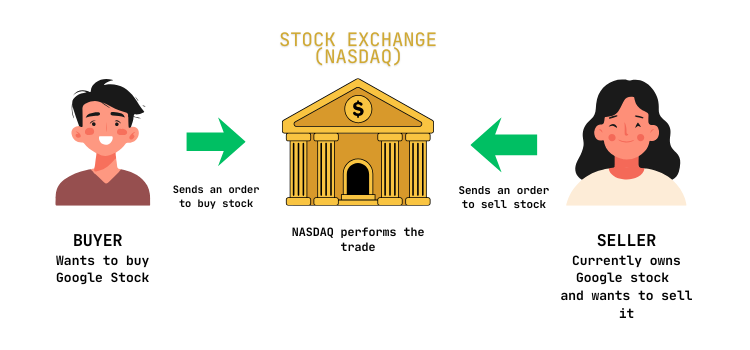
So when you’re buying/selling stocks of a specific company, you are doing this trade via the stock exchange of where that company is listed. For example, I’m currently living in London, and I decide to buy some stock of Google (currently listed on the NASDAQ, which is based in the US) – this trade actually goes through to NASDAQ (*for anyone else who had the same misconception like me, when I first started on my investing journey, I thought any trade I made in the UK is done via the London Stock Exchange since that’s where I lived!)
Fig 1.1 — A simplified illustration of how buying and selling stocks works
If you want to check whether a company is publicly traded, simply search the company name followed by the word “stock” (e.g. “Apple stock”) and you will be shown the relevant stock information; if it doesn’t show this information then you can presume the company is private.
1.5 Why would you buy stocks?
Now that we have understood the concept of the stock market, let’s think about why people would buy stocks? One of the primary reasons to buy stocks is in order to make more money – this is done by buying a stock at a certain price, and selling it back at a higher price, making a profit.
The stock market offers a great range of diversity (as there are thousands of companies that you can buy stock of), making it a great choice for a majority of people to “invest” in; it helps them to grow their money and create wealth for their future. This is also where most of my personal portfolio is currently invested in, and it’s something I’ll be covering in much more detail throughout this series
And that’s the stock market in a nutshell! If I had to summarise the stock market in one sentence – it’s a marketplace where buyers and sellers trade shares of companies. Hopefully this post has provided you with a good understanding of what a stock market is, and made things less intimidating than before.
In the next post of the “Stocks 101” series, we will be covering the fundamental concepts of the stock market that every beginner investor should understand. See you there!
Got any questions so far? Feel free to drop them in the comments below.