STOCKS 101 #3 – Mutual Funds and ETFs: Smart Investing
So by now, you should have a decent understanding of what the stock market is and some of the core concepts around it. But there’s probably a question you’ve been asking for a while — “How do I actually start investing?”
And the honest answer is — there’s more than one way to do it, and some are much simpler than you might think! When I first started back in 2018, I assumed I had to jump straight into buying individual stocks. This felt way too overwhelming at the time; imagine going through a list of hundreds of different companies > then researching the ones you’re interested in > and then having to choose which ones to invest in – how stressful would that be!?
Instead, I learnt of something called a “fund”, and it was genuinely one of the best decisions I made, as it made things much simpler, especially as a beginner. In this post, we will go through 2 of the most popular ways that people invest in the stock market – mutual funds and ETFs.
In this post, you’ll learn:
- What mutual funds are and how they work
- What ETFs are and how they differ from funds
- The costs involved with both options
3.1 What is a mutual fund?
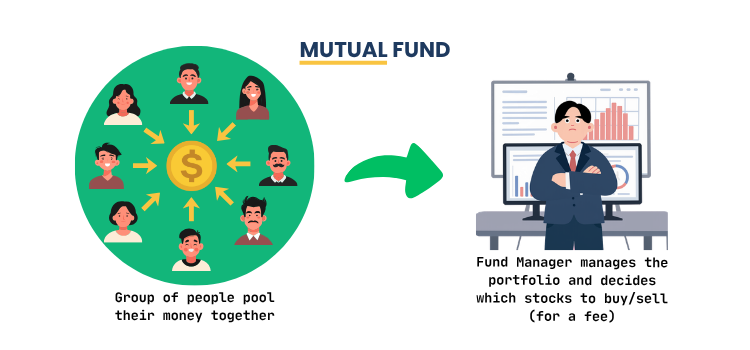
Let’s say you had a friend who was really good at investing and had good track record of making money from it. Since you’re not much familiar with the stock market, you ask him if he could take your money and invest it on your behalf, and he agreed to do it for a small fee. He offers this to the rest of your friend group, and now he manages portfolio for all of them as well.
Replace your friend with a large investment company, then imagine several investors pooling their money together and giving it to this company to invest, and there you have the concept of mutual funds – it’s a diverse stock portfolio (called ”funds”) that is professionally managed by them.
There are various different types of funds that are available, for e.g. funds that are focuses on technology, funds focusing on Asian companies, funds focusing on real estate, etc. Due to the diversification that it offers, funds are a great choice for investors to invest in; when I first started my journey, I invested in a popular UK fund from a company called Fundsmith as it was a simple and easy option.
Just like your friend, these companies will charge you an annual fee – normally a small percentage of your investment, and this fee will vary depending on the fund. This annual percentage fee is known as an “expense ratio” (so if you buy a fund worth £1000, and it has an expense ratio of 1%, then your cost of owning this fund for a year is £10); the fee is taken away automatically by the fund, so you don’t need to do anything about it. You can buy funds in the same way as you would buy stocks, but there are specific platforms which will offer you more choices of funds.
The size of the fund is one of the key metrics to look out for – this is known as “Asset under management” (AUM), and it tells you the total value of money currently invested in that fund by all investors. As funds are several investors pooling their money together, you’d typically find most funds to have a large AUM, from several millions to billions.
Funds can be split into 2 categories – active and passive.
- Active funds are ones where it is being actively managed – there is usually a “fund manager” who is in charge of the fund; they will be responsible for what stocks are bought and sold into the fund. So the stocks that are contained within these funds will change depending on what the fund manager decides. These funds will normally have a larger fee than passive funds.
- Passive funds (commonly referred to as “index funds”) are ones where the fund is basically copying one of the stock indexes. Earlier we learnt about the S&P 500 – so imagine a fund which holds all those 500 companies within the S&P 500, and all you need to do is buy this one fund to own all those 500! The fees for these passive funds are cheaper because no fund manager has to actively buy/sell stocks, they simply need to track what companies are within the S&P 500
Fig 1 — illustration of how a mutual fund works
3.2 What is an ETF?
Let’s say you’re interested in a specific sector and have a lot of belief that this sector will perform greatly in the future; right now in 2026, the “AI” sector is very hot at the moment, so let’s use that as an example. You want to invest in companies that are related to AI, but when you do your research there are just too many AI companies that you are interested in, and you want to buy them all!
Now, you could technically buy each of those companies stocks individually, but that would be a lot of admin work to manage in your portfolio – imagine there are 20 different companies, and you have to buy/sell these one at a time. You think to yourself, wouldn’t it be great if there was one single stock which held all those 20 companies together? Well, there you have the concept of an ETF (”Exchange Traded Fund”) – think of these as various different stocks combined into one stock, and this one stock can be traded exactly as any other stocks!
There are various different types of ETFs:
- Index ETFs – these are the most popular ones. Similar to Passive funds from the previous section, these ETFs will hold the stocks that are in those stock indexes (e.g. S&P 500, or the NASDAQ 100).
- Sector ETFs – these are ETFs that relate to specific sectors, e.g. renewable energy, technology, banking, etc.
- Commodities ETFs – these ETFs allows you to invest in commodities such as gold, silver, oil and gas
“Don’t put all your eggs in one basket” – you may have heard this popular saying, which basically means to not put all your trust into one single thing (i.e. not put all your money into one single stock), because there’s a risk that you drop that basket and crack all those eggs in one go (i.e. if that single stock performs badly, or even worse goes bankrupt, then your entire investment fails). Hence why it’s a very good idea to diversify your portfolio to include more than just one stock; this makes ETFs a great option for diversification. To show the effects of diversification, below is a comparison of an ETF vs an individual stock (*note: just for demonstration purposes, I have chosen a stock like Tesla, which is known to be a very volatile stock. So don’t think all individual stocks behave similar to this!) – you can clearly see the difference in the stock price movements between the two. This doesn’t mean individual stocks are always risky — but it shows how diversification can reduce volatility
Fig 2 — comparison of S&P 500 ETF vs Tesla stock, over the last 5 years
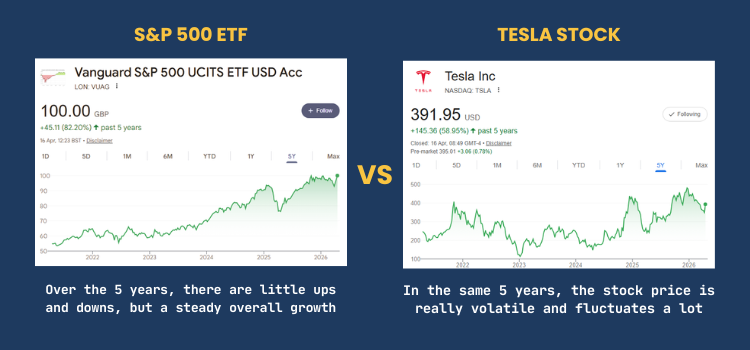
Similar to mutual funds, you have to pay fees (expense ratio) to hold ETFs and this will vary depending on the ETF. Index ETFs have very low fees making them very popular with investors (for instance, I currently hold the S&P 500 ETF by Vanguard shown in the illustration above, and it has an expense ratio of only 0.07%!) , whereas specific ETFs would charge higher fees (for e.g. the Solar ETF by Invesco , Ticker: TAN, has an expense ratio of 0.70%). While the difference may seem negligible at a glance, the cost adds up once you have a larger size of investment.
There are several providers of ETFs, the two mentioned above (Vanguard and Invesco) are some of the largest and reputable. To find out more details of a specific ETF, you just need to search on website of the ETF provider, who will list all the necessary information such as what stocks are held in that ETF and the percentage of each stock.
3.3 What is the difference between Mutual Fund & ETF?
Learning about each of them, you may have already noticed that there are a lot of similarities between the two (especially Index Fund and Index ETF) – so what exactly is the difference between them? Their primary difference is the way that they can be traded – ETFs are traded throughout the day (like a normal stock), whereas mutual funds are bought/sold once at the end of the day. And also ETFs generally have a smaller fee compared to funds
As you can see, Funds and ETFs are great ways to invest in the stock market, without having to pick individual stocks yourself. For a lot of people, these options are not only simpler, but often more effective in the long run. And here’s a fun fact — a lot of actively managed mutual funds actually fail to beat the S&P 500 over the long haul. So they are less risk, less hassle, but still great potential for growth – what’s not to like about it
Next up in the “Stocks 101” series, we’re going to cover how you can generate income from stocks — via a concept known as “Dividends”. See you there!
As always, if you have any questions, feel free to drop them in the comments below.